


Why Do Ordained Practitioners Beg for Food?
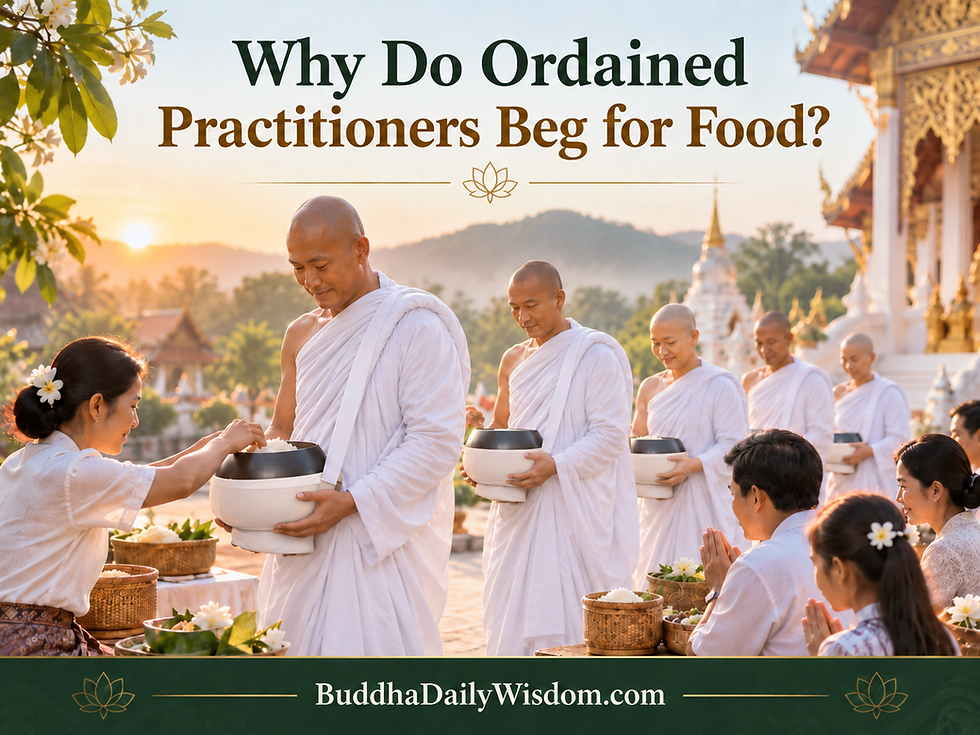
Ordained Practitioners, including both male and female Ordained Practitioners, traditionally receive food and other necessities that are freely offered as part of The Buddha’s practice of mutual support.
It is a common misunderstanding to see an Ordained Practitioner receiving food or other necessities from Household Practitioners and conclude that they are “begging.” However, this is not what The Buddha established nor what an Ordained Practitioner is doing. An Ordained Practitioner is not begging for food, money, possessions, or anything else. Instead, the practice of receiving offerings exists within a much broader practice of mutual support in which Ordained Practitioners and Household Practitioners assist one another in learning, practicing, developing, and progressing on The Path to Enlightenment.
Within this lifestyle, Ordained Practitioners dedicate significant portions of their lives to learning, reflecting on, practicing, and sharing The Teachings of The Buddha. Household Practitioners continue living within household life while having access to Teachers who can help them understand The Teachings and learn how to apply them to their own lives. At the same time, Household Practitioners are provided with opportunities to voluntarily offer food, clothing, shelter, medical care, financial support, time, effort, energy, or other resources that help sustain the Teacher and support the continued sharing of The Teachings of The Buddha.
This relationship is not intended to be a commercial transaction in which one person provides a service and another person purchases it. It is a relationship based on generosity in which both Teacher and Student have opportunities to give without expectation of receiving something in return. The Teacher gives and shares The Teachings. The Student gives and shares resources. Through this process, both have opportunities to develop the mind and practice qualities that are necessary for progress towards Enlightenment.
Therefore, what may appear from the outside to be begging is actually an opportunity for both the Ordained Practitioner and Household Practitioner to practice generosity while supporting one another’s development on The Path to Enlightenment.
The Buddha’s Practice of Mutual Support
As part of The Teachings, The Buddha established a practice of mutual support between Ordained Practitioners and Household Practitioners. This practice allows each group to support the development of the other while also creating opportunities for both to practice generosity.
An Ordained Practitioner who dedicates their life to The Teachings is making a significant commitment. Rather than organizing their life around a career, the accumulation of possessions, financial success, social status, entertainment, and the many pursuits of worldly life, they are attempting to create conditions that allow them to devote much greater attention to learning and practicing The Teachings. This does not mean that an Ordained Practitioner immediately eliminates all craving/desire/attachment simply because they become ordained. Rather, they are establishing a way of life that is intended to help them work towards the gradual elimination of craving/desire/attachment and the development of wisdom.
Household Practitioners generally live in very different conditions. They may have careers, families, homes, possessions, financial responsibilities, personal relationships, and many other responsibilities associated with household life. While living within these conditions, they will encounter the struggles, difficulties, disappointments, conflicts, and uncertainties that arise from an untrained mind and a lack of wisdom regarding The Natural Laws of Existence. It is through learning and practicing The Teachings of The Buddha that a Household Practitioner can gradually improve the condition of the mind and learn how to create a more peaceful and joyful life.
For this reason, Teachers and Students can be of tremendous benefit to one another. The Teacher dedicates their life to deeply learning and practicing The Teachings so that wisdom can be cultivated and shared. The Student helps provide the resources necessary for the Teacher to sustain their life and continue this work. The Teacher's generosity contributes to the development of the Student, while the Student's generosity contributes to the Teacher’s ability to continue learning, practicing, developing, and sharing The Teachings. Both are participating in a practice designed to help each individual progress on The Path to Enlightenment.
A Great Teacher First Needs to Be a Great Student
A Teacher of The Teachings of The Buddha would first be a deep and dedicated Student and Practitioner. It would be difficult for someone to wisely guide others in developing their mind if they have not devoted substantial effort to understanding and practicing The Teachings within their own life. A Teacher therefore needs the time, discipline, determination, and diligence necessary to study The Teachings, reflect on them to independently verify them, apply them, observe the results, and gradually cultivate wisdom through direct practice.
To be the very best Teacher, one first needs to become a very deep and dedicated Student and Practitioner.
This is one of the important reasons Ordained Practitioners traditionally need offerings for the basic necessities of life. If a Teacher were required to devote most of their time and mental energy to developing a career, pursuing financial success, accumulating possessions, and managing the many responsibilities connected with worldly life, they would naturally have less time available for deep study, practice, meditation, teaching, and guiding Students. By living more simply and accepting resources freely offered, an Ordained Practitioner can create more favorable conditions for developing their practice.
The support offered by Students therefore has a purpose beyond merely providing a Teacher with food or other material necessities. Those offerings help provide the conditions that allow a Teacher to devote more of their life to developing wisdom. As the Teacher develops greater wisdom through learning and practice, that wisdom can then be shared with Students to help them improve their own understanding and practice. In this way, the Student's generosity assists the Teacher in progressing on The Path, while the Teacher's generosity assists the Student in progressing on The Path.
This is the essence of the practice of mutual support. The Teacher and Student are not simply one person who gives and another who receives. Both are giving, both are supported through the relationship, and both are provided with opportunities to develop.
Generosity Is Essential to The Path
Generosity is a significant aspect of practice that needs to be developed by a Practitioner who sincerely aspires to progress towards Enlightenment. Generosity is not limited to giving money, food, or material possessions. It includes the development of a mind that becomes increasingly willing to give time, effort, energy, knowledge, resources, and assistance without expecting something in return.
Generosity is a readiness and taking the action of frequently giving something more than is strictly necessary, such as time, effort, energy, financial support, or resources without any expectation of anything in return. It is a practice of giving and helping others as part of an ongoing and comprehensive life practice. This practice can help a person develop and cultivate a more caring and compassionate mind as they consistently choose to give and share throughout life to eliminate selfishness. Generosity eliminates craving/desire/attachment in the mind and, thus, helps to eliminate discontentedness from the mind.
The importance of generosity becomes clearer when we understand that the objective of The Path to Enlightenment is the gradual elimination of craving/desire/attachment. A selfish mind is continuously engaged in acquiring, possessing, controlling, protecting, and holding onto what it desires. Generosity begins training the mind in the opposite direction. Rather than continually asking, “What can I get?”, a Practitioner begins developing a mind that is increasingly willing to ask, “What can I give?”
Through a regular and consistent practice of generosity, a person can begin to loosen their attachment to possessions, money, time, personal convenience, and self-interest. The value of generosity therefore extends far beyond the object that is given. The most significant change occurs within the mind of the person who gives.
Generosity without judgment or expectation of anything in return is a practice that can transform the mind in ways you may never have thought possible.
This is why both Teachers and Students need opportunities to practice generosity. A Teacher practices generosity by freely sharing The Teachings, their time, their knowledge, their wisdom, and their effort. A Student practices generosity by voluntarily providing support without being required or pressured to do so. Each individual is training the mind through giving.
How Teachers and Students Support Each Other
A Household Practitioner generally continues living within worldly life. They may have a career, financial obligations, family tasks, personal relationships, possessions, goals, and many other aspects of daily life that need attention. Throughout these experiences, the individual will inevitably encounter changing conditions, disappointments, losses, conflicts, uncertainty, and other challenges.
When the mind contains craving/desire/attachment, these changing conditions will produce discontentedness. The individual may not understand why they are repeatedly dissatisfied, frustrated, angry, worried, fearful, jealous, disappointed, or emotionally disturbed by the conditions they encounter. Without wisdom regarding The Natural Laws of Existence and without training the mind according to The Teachings of The Buddha, it can be extremely difficult for a person to understand the true cause of these experiences.
A knowledgeable Teacher can help a Student learn how to recognize these causes, understand The Teachings, and gradually develop a life practice that leads towards an improved condition of mind. However, for Teachers to be available, there need to be conditions that allow them to devote substantial time to becoming knowledgeable Practitioners themselves.
This is where the Household Practitioner becomes an important part of the continuation of The Teachings. Because the Teacher has devoted their time and effort to learning, practicing, and sharing The Teachings, Students may voluntarily provide the life-sustaining necessities and resources that allow the Teacher to continue doing so. The relationship becomes mutually supportive because the Teacher helps provide wisdom while the Student helps provide the physical resources that allow the teaching to continue.
Neither side would be wise to approach this relationship with selfish expectations. A Teacher would be unwise to share The Teachings while thinking, “I will only teach if you give me something.” Likewise, a Student's generosity would ideally not be motivated by the expectation of receiving special treatment, recognition, status, favors, or personal benefits from the Teacher. Both individuals are learning to give because generosity itself is part of the practice.
Why The Teachings Are Wisely Shared Without Requiring Payment
A Teacher who is sincerely practicing The Teachings of The Buddha would be wise to strive to develop a well-established practice of generosity. This means being willing to share The Teachings with people who have a sincere interest to learn without making financial payment a requirement for access.
When a Teacher requires payment before a person can attend a class, course, retreat, or other learning opportunity, access to the wisdom becomes dependent upon the Student's financial circumstances. Someone with sufficient money can participate, while someone experiencing financial hardship may be excluded. This creates a serious difficulty because the individual who is struggling financially may be among those who most need the wisdom contained within The Teachings.
The difficulties a person experiences in life can be connected to a lack of wisdom. An individual may not understand how their intentions, decisions, actions, habits, relationships, and mental states are contributing to the conditions they repeatedly experience. Learning The Teachings can help that person develop greater wisdom and begin making decisions that produce improved results. However, if the very wisdom needed to improve their condition is inaccessible because of a required fee, the individual may remain trapped within the same difficulties that prevent them from paying for the instruction.
Offering The Teachings at no cost removes this financial obstacle. The person who has significant financial resources can attend. The person who has very little can attend. The person whose life is stable can attend, and the person who is struggling can attend. The availability of The Teachings is not determined by someone's ability to pay.
This approach allows The Teachings of The Buddha to remain accessible to the widest possible audience and creates a powerful opportunity for the Teacher to practice generosity. Rather than measuring Students according to what they can financially provide, the Teacher focuses on helping those who sincerely aspire to learn.
No Cost Does Not Mean There Is No Cost to Teach
Although a Teacher may provide classes, courses, retreats, and other learning opportunities at no cost to Students, this should not be confused with the idea that there are no expenses involved in sharing The Teachings.
Every Teacher still needs the basic necessities to sustain life, including food, water, clothing, shelter, and medical care. In the modern world, sharing The Teachings with a larger community can also necessitate substantial additional resources. A Teacher may need a website, video conferencing services, computers, cameras, lighting, microphones, meditation cushions, chairs, classroom supplies, signs, transportation, internet services, publishing resources, and many other tools that make it possible to teach both locally and throughout the world.
Therefore, there is an important distinction between saying that The Teachings are offered at no cost to the Student and saying that there is no cost involved in offering The Teachings. A Teacher may need financial resources to maintain the physical and technological resources necessary to continue teaching, even though no individual Student is required to pay a fee.
If Students value having access to The Teachings and appreciate the opportunity to learn from a Teacher who offers classes and programs without required payment, they are given an opportunity to voluntarily support the continuation of that work. Some Students may provide food. Some may donate financially. Others may contribute time, effort, transportation, equipment, supplies, technical assistance, or other forms of support. The exact form of generosity may differ according to the individual's circumstances.
The important point is that the support is freely given rather than expected, required, or demanded in order to learn The Teachings of The Buddha.
Why Receiving Offerings Is Not Begging
The distinction between receiving an offering and begging is important because the mental qualities involved are very different.
Begging generally involves wanting something from another person and actively requesting, pleading, or attempting to persuade that person to provide it. From the perspective of The Teachings, this can easily become connected with craving/desire/attachment and expectation.
An Ordained Practitioner would be wise to instead develop the ability to await what is given. They would not approach Students with the expectation that something must be provided, nor would they judge Students according to whether or how much they give. The Teacher continues learning, practicing, teaching, and sharing. If support is offered, it can be accepted and wisely used. If support is not offered, the Teacher would be wise not to become angry, disappointed, resentful, or demanding.
This protects the practice of generosity on both sides. If a Teacher expects someone to give, that expectation itself is craving/desire/attachment because the Teacher wants the Student to act according to the Teacher’s own desire. The Student’s action may therefore no longer arise freely from their own generosity. If the Teacher charges a mandatory fee, the relationship becomes a financial exchange. But when the Teacher gives freely and the Student independently chooses to give freely, both have an opportunity to practice generosity without expectation, thereby helping to reduce and eliminate craving/desire/attachment.
Therefore, when an Ordained Practitioner receives food during an alms round or receives other forms of support, it would be a misunderstanding to conclude that the Practitioner is begging. They are making themselves available to receive what others freely choose to offer while attempting to maintain a mind without expectation or craving/desire/attachment towards those offerings.
The Responsibility of the Teacher
Within the practice of mutual support, a Teacher willingly accepts the responsibility to use the resources that are freely offered in a way that is consistent with their practice and their commitment to sharing The Teachings. Because these resources are given through the generosity of Students, it would be wise to use them to sustain the Teacher’s life and support the continued sharing of The Teachings, rather than directing them towards the accumulation of possessions, luxury, status, or personal financial success.
A Teacher may use offerings to provide the necessities to sustain life, including food, water, clothing, shelter, and medical care. Additional resources may appropriately be used to support the continued sharing of The Teachings through classrooms, transportation, equipment, websites, publications, technology, meditation facilities, and other resources that benefit Students and the wider Community.
The Teacher would be wise to continually observe their own mind and intentions regarding these resources. Are they simply using what is needed to sustain life and continue sharing The Teachings, or are they beginning to develop craving/desire/attachment towards money, possessions, comfort, recognition, or status? Are they accepting what is freely offered, or are they developing expectations regarding what Students should provide? Are the resources being used in ways that genuinely support The Teachings, or are they gradually being redirected towards worldly desires?
Ordination does not eliminate the need for practice. The Teacher remains a Practitioner who needs to continually observe and train their own mind. The way offerings are received, regarded, and used becomes another part of that practice.
The Opportunity for the Student
The Student also has an important opportunity within this relationship. When a Household Practitioner voluntarily gives food, financial resources, supplies, time, effort, energy, or other support to a Teacher, Ordained Practitioner, or Temple, they are not simply providing assistance to another person. They are participating in their own training of the mind.
Every act of genuine generosity provides an opportunity to weaken selfishness and attachment. The Student practices allowing resources to leave their possession without expecting something in return. They learn that they can contribute to something beneficial without demanding recognition, control, special privileges, or repayment.
At the same time, their generosity helps maintain the conditions that allow The Teachings to remain available. Their offering may help provide food for a Teacher, pay for classroom supplies, maintain a website, provide meditation cushions, purchase a microphone, pay transportation expenses, or support countless other needs involved in sharing The Teachings. The benefit can therefore extend far beyond the individual Teacher who receives the offering.
One act of generosity may contribute to many people learning The Teachings, even though the original donor may never personally meet those individuals.
This illustrates how the practice of mutual support functions. The Teacher is supported in continuing their learning, practice, and teaching. Students continue to have access to The Teachings. New individuals are given opportunities to learn. And the person who gives develops their own practice of generosity as they work towards eliminating craving/desire/attachment from the mind.
What Happens Without Mutual Support?
The importance of the practice of mutual support becomes even clearer when we consider what happens when this practice begins to disappear.
If Teachers are unable to receive the support necessary to sustain their lives, many will need to devote substantially more of their time to earning income through careers or other forms of work. As more time and energy are directed towards financial survival and worldly responsibilities, less time would be available for learning, meditation, practice, teaching, writing, guiding Students, organizing retreats, and preserving The Teachings for future generations.
Students would then have fewer knowledgeable Teachers available to help them understand and practice The Teachings. At the same time, Household Practitioners would lose a valuable opportunity to develop their own practice of generosity through supporting those who dedicate their lives to learning and sharing The Teachings of The Buddha.
If everything becomes commercialized, another difficulty arises. Teachers may begin measuring the success of their work according to enrollment, income, sales, or financial growth. Students may begin viewing The Teachings as another product or service that is purchased rather than wisdom that needs to be learned, reflected upon, practiced, and directly verified within one's own life to experience the results of Enlightenment.
The practice of mutual support established by The Buddha provides a different way for Teachers and Students to support one another. Teachers generously share The Teachings. Students generously provide support. Neither would be wise to demand from the other. Both are supported. Both develop. Both practice.
This is why the practice of mutual support is so important to the continued availability of The Path to Enlightenment as taught by The Buddha.
The Buddha’s Teaching on Mutual Support
The Buddha directly described this relationship between those who dedicate their lives to spiritual practice and those living within household life:
“Monks, Brāhmins and Householders are very helpful to you. They provide you with the requisites of robes, almsfood, lodgings, and medicines in time of sickness. And you, Monks, are very helpful to Brāhmins and Householders, as you teach them The Teachings that are good in the beginning, the middle, and the end, with the correct meaning and wording, and you proclaim the spiritual life in its fulfillment and complete purity. Thus, Monks, this spiritual life is lived with mutual support for the purpose of crossing the flood and making a complete end of discontentedness.”
(Reference: ITI 107)
This passage clearly expresses the two directions of support. Household Practitioners provide the physical necessities needed by Teachers who dedicate their lives to learning, practicing, and sharing The Teachings. Household Practitioners, in turn, dedicate themselves to practice by actively learning and applying The Teachings in daily life. Neither side exists independently of the other. Together, they create the ability for the spiritual life to continue while providing individuals in present and future generations with opportunities to progress towards the complete elimination of discontentedness.
Keeping The Path Accessible to All Beings
The practice of mutual support allows both Teachers and Students to participate in the continued preservation and sharing of The Teachings of The Buddha while developing their own practice. The Teacher continues learning, practicing, developing wisdom, and generously sharing The Teachings without requiring payment, while the Student is provided with the opportunity to learn and practice generosity through freely offering support. In this way, neither Teacher nor Student is merely giving to or receiving from the other. Both are participating in a practice that supports their continued development on The Path to Enlightenment.
When this practice is understood and maintained, The Teachings can remain available to individuals regardless of their financial circumstances and Teachers can continue dedicating their lives to learning, practicing, and sharing the wisdom that leads to the elimination of craving/desire/attachment and discontentedness. The continued availability of knowledgeable Teachers and accessible Teachings is therefore not sustained through commercial exchange, but through the voluntary generosity of those who teach and those who learn.
Through a regular, consistent, and ongoing practice of generosity by Teachers and Students, the practice of mutual support wisely established by The Buddha can continue from one generation to the next. In this way, Teachers have the conditions needed to continue sharing The Teachings, Students have the opportunity to learn and develop regardless of their ability to pay, and both have opportunities to cultivate generosity and progress towards Enlightenment. Through this practice of mutual support, The Path to Enlightenment remains intact and accessible to all beings.
To learn more about producing wholesome Kamma through the practice of generosity, see The Natural Law of Kamma — Volume 6 and Generosity — Volume 13 from The Words of The Buddha book series.

David Roylance is a dedicated Practitioner, Teacher, and published author who has taught The Teachings of The Buddha since 2005. Based in Chiang Mai, Thailand, he guides Household and Ordained Practitioners worldwide through courses, retreats, and special events on The Path to Enlightenment.


Comments