


What is Enlightenment in Buddhism? A Complete Guide to Awakening
Updated: Sep 3

The ultimate goal of learning and practicing The Teachings of The Buddha is the attainment of Enlightenment.
But what exactly is Enlightenment? What does an Enlightened being experience? And how does a Practitioner progress toward this complete transformation of the mind and their life?
This guide will help you develop a clearer understanding of Enlightenment, The Path that leads to it, the qualities of an Enlightened mind, and several common misunderstandings surrounding awakening.
For those who aspire to attain Enlightenment, this guide will also provide a practical overview of how to begin and continue progressing along The Path to Enlightenment.
Let us begin.
Table of Contents
Summary
Enlightenment is the complete and permanent purification of the mind. An Enlightened being has eliminated craving, anger, and ignorance (unknowing of true reality)—the causes of discontentedness—and experiences lasting peace, calm, serenity, contentment, and joy.
The Path to Enlightenment is a gradual process of learning, reflecting on, and practicing The Teachings of The Buddha to train the mind. Through The Eight Fold Path, meditation, moral conduct, and the development of wisdom, a Practitioner directly investigates The Teachings and gradually transforms the mind.
Enlightenment is not attained through blind belief, rites, rituals, ceremonies, worship, or prayer. It is attained through diligent and consistent practice that trains the mind, develops wisdom, and leads the Practitioner to directly understand true reality.
What Does Enlightenment Mean?
Enlightenment is a fully transformed mental state in which the mind is permanently peaceful, calm, serene, content, and joyful.
The Enlightened mind has completely eliminated all discontentedness. It is concentrated, steady, and unshakable—calm and relaxed while remaining attentive and alert.
An Enlightened mind is completely free from:
An Enlightened being experiences these wholesome qualities for the remainder of their life:
Peaceful: Free from disturbance; tranquil.
Calm: Free from nervousness, agitation, and mental excitement.
Serene: Peaceful, untroubled, and tranquil.
Content: Completely satisfied, without needing circumstances to be different.
Joyful: Experiencing unconditioned gladness that is not dependent on acquiring or maintaining a particular object, relationship, experience, or circumstance.
These qualities are permanent because they are not dependent on impermanent conditions.
Ordinary happiness arises when the mind receives something it wants. Because the object or condition is impermanent, that happiness eventually changes or disappears.
The peace and joy of the Enlightened mind are different. They are not produced by craving or attachment and, therefore, are not destroyed when circumstances change.
While Enlightenment is the mental state that is attained, The Path to Enlightenment is the gradual purification and development of the mind.
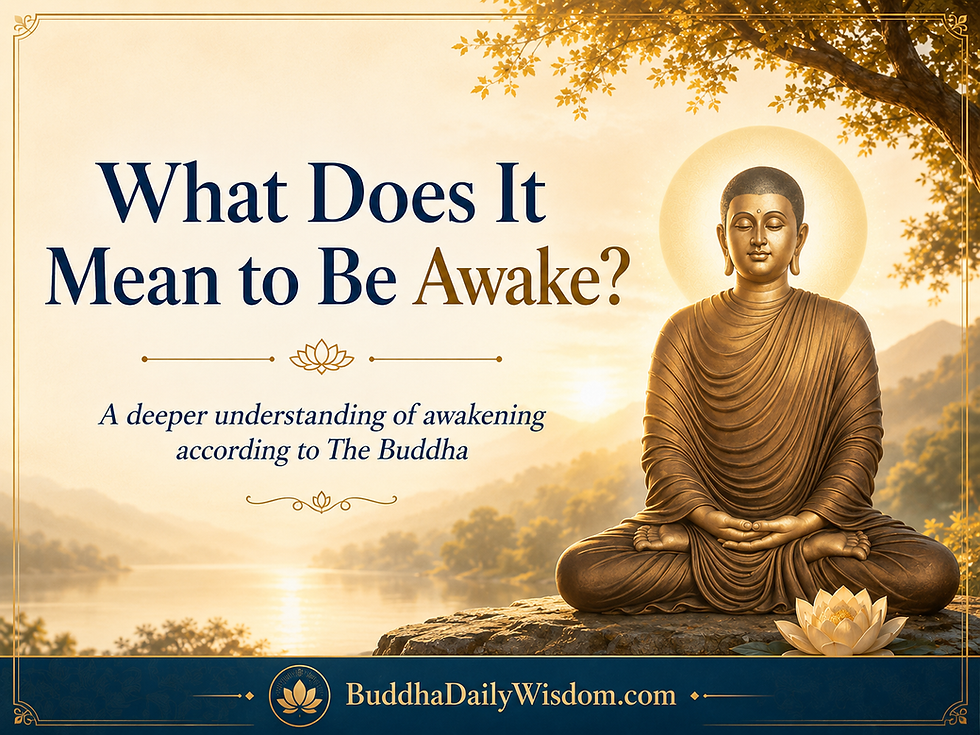
A Practitioner progresses by choosing to perform the necessary inner work, cultivating wisdom, abandoning unwholesome qualities, and developing wholesome qualities through consistent training. Learn more about What Does It Mean to Be “Awake”?
Why Is The Buddha Called “The Awakened One” or “The Perfectly Enlightened One”?
The title Buddha means an Awakened One—a human being who independently discovers The Path to Enlightenment without being guided to awakening by a living Teacher.
By the time a Buddha attains Enlightenment, they deeply and completely understand the causes of discontentedness, the elimination of discontentedness, and the practices that lead to freedom from discontentedness.
Anything that did not contribute to awakening has been recognized and abandoned.
A Buddha then dedicates the remainder of their life to helping others understand and practice the same Path that led to their Enlightenment.
Through their Teachings, a Buddha illuminates The Path to Enlightenment for the world. It is as though they place lights along a previously dark path so that others can clearly see where to walk.
A Buddha is not merely someone who has attained a particular Stage of Enlightenment. A Buddha is a unique type of Enlightened being.
A Buddha is an Arahant who has attained Enlightenment through an independent journey of investigation, practice, and realization rather than through the direct guidance of a living Teacher.
For all other Practitioners, Teachers and Guides are essential. A Buddha, however, independently rediscovers the complete Path.
The Three Primary Qualities of a Buddha
A Fully Perfectly Enlightened Buddha meets three primary criteria.
1. A Buddha Independently Discovers The Path to Enlightenment
A Buddha eliminates The Ten Fetters and attains Enlightenment as an Arahant.
However, this awakening occurs through an independent journey, without the assistance of a living Teacher guiding them through The Path to Enlightenment.
Through investigation, observation, reflection, meditation, and direct experience, a Buddha discovers the principles and practices that lead to complete freedom of mind.
This is what makes the appearance of a Buddha extraordinarily rare.
2. A Buddha Guides Countless Beings Toward Enlightenment
After attaining Enlightenment, a Buddha does not keep this wisdom to themselves.
They dedicate the remainder of their life to teaching others how to eliminate discontentedness and attain freedom.
A Buddha has the wisdom and teaching ability necessary to guide countless beings toward Enlightenment. Their life becomes an example of their Teachings, and their conduct demonstrates what a fully purified mind looks like in daily life.
3. A Buddha Leaves Teachings That Continue After Their Death
A Buddha establishes their Teachings in a form that can continue benefiting the world after their death.
Their Students learn, practice, preserve, and share those Teachings so that future generations can continue progressing toward Enlightenment.
A Buddha has already completed the difficult work of discovering The Path. Others do not need to rediscover it independently. They need to learn, reflect on, and practice The Teachings that The Buddha has made available.
A Buddha may be referred to as:
A Fully Perfectly Enlightened Buddha
A Perfectly Enlightened One
An Awakened One
A Tathāgata
A Buddha is a human being, a Teacher, one who possesses profound wisdom, and deep loving-kindness and compassion for all beings.
The Rare Appearance of a Buddha
The arising of a Buddha in the world is extremely rare.
The most recent Buddha known to the world was Gotama Buddha, who lived and taught more than 2,500 years ago.
The Buddha explained the rarity of both an Awakened Teacher and those who can understand and practice The Teachings he shared.
The appearance of a Tathāgata, an Arahant, a Perfectly Enlightened One is rare in the world.
(Reference: AN 5.195)
This Teaching shows how rare it is for a Buddha to arise in the world.
A person can attain Enlightenment by learning and practicing The Path to Enlightenment taught by a Buddha, but this does not mean that every Enlightened being becomes a Buddha.
The idea that everyone is already a Buddha, possesses an inherently Enlightened “Buddha nature,” or will attain Buddhahood is not part of The Teachings of The Buddha.
A Buddha is a rare and distinct type of Enlightened being.
What Causes Discontentedness?
Discontentedness includes mental experiences such as:
Sadness
Anger
Frustration
Irritation
Annoyance
Guilt
Shame
Fear
Boredom
Loneliness
Shyness
Jealousy
Resentment
Stress
Anxiety
The cause of these discontent feelings is craving, desire, attachment, wants, and expectations—the mind’s longing and yearning for the objects of its affection.
The unEnlightened mind craves people, objects, experiences, and circumstances to remain as it wants them to be. It craves permanence.
However, everything in the conditioned world is impermanent.
People change. Relationships change. Bodies change. Possessions deteriorate. Pleasant experiences end. Circumstances arise and pass away.
When the mind can only be happy when it receives what it wants, happiness becomes dependent on unstable conditions.
Even when the mind temporarily acquires what it desires, impermanence remains. Eventually, the desired object changes, disappears, or no longer produces the same satisfaction.
Therefore, a mind that craves permanence in an impermanent world cannot experience permanent peace.
The Four Noble Truths explain:
Discontentedness
The cause of discontentedness
The elimination of discontentedness
The way leading to the elimination of discontentedness
The Four Noble Truths are foundational to understanding Enlightenment because they explain both the problem and its solution. Learn more about the cause of discontentedness with an in-depth recorded class that teaches The Four Noble Truths or a live class.
Wisdom and The Natural Laws of Existence
To attain Enlightenment, a Practitioner needs to cultivate wisdom.
In the unEnlightened state, the mind lacks wisdom regarding The Natural Laws of Existence. As a result, it struggles within a world it does not fully understand.
The mind lacks wisdom regarding:
How the mind functions
How craving produces discontentedness
How decisions produce results
The impermanent nature of conditioned things
The relationship between moral conduct and the results experienced
The way leading to the complete elimination of discontentedness
Without wisdom, the mind makes unwise decisions that produce unwholesome results, or unwholesome Kamma.
It may then blame other people, society, circumstances, or the world for the results it is experiencing rather than examining the decisions and mental qualities that contributed to those results.
Wisdom allows the Practitioner to understand cause and effect clearly. Learn more about how The Natural Law of Kamma influences the results of our decisions.
Understanding Wisdom Through the Example of Gravity
At one time in our lives, we did not understand the natural law of gravity.
As young children, we fell down, bumped our heads, dropped objects, and broke toys. We cried because we did not understand the world in which we were living.
Over time, we developed wisdom regarding gravity.
We did not merely adopt a belief in gravity. We repeatedly observed its effects and verified its existence through direct experience.
As our understanding increased, our decisions became wiser.
We learned to:
Tie our shoes securely
Pay attention to the surface beneath our feet
Use ladders carefully
Balance while riding a bicycle
Design buildings, vehicles, and airplanes in harmony with natural laws
Once we understood gravity, we stopped struggling with it in the same way.
Gravity continued to operate, but our wisdom allowed us to live in harmony with it.
In this sense, we became “awake” to the reality of gravity.
The same principle applies to the other Natural Laws of Existence.
These laws affect the mind and our life whether we understand them or not. When the mind lacks wisdom, it repeatedly makes decisions that conflict with reality and then experiences discontentedness or the unwholesome results of our unwise decisions.
The goal of The Path to Enlightenment is to cultivate wisdom so that the mind can live in harmony with true reality.
There is no requirement to blindly believe The Teachings of The Buddha. I would encourage you not to believe anything at all.
A Practitioner needs to:
Learn The Teachings.
Reflect on them by independently examining and verifying their meaning.
Practice them in daily life.
Observe the results.
Through this process, belief is gradually replaced by direct understanding and wisdom.
As wisdom develops, the Practitioner becomes increasingly capable of navigating life peacefully. With complete wisdom and purification, the mind no longer produces discontented feelings.
The Four Stages of Enlightenment
The Buddha described four Stages through which a Practitioner progresses toward the complete attainment of Enlightenment.
These Stages provide a framework for understanding personal growth and the gradual elimination of the mind’s pollutions.
1. Stream-Enterer
A Practitioner who has entered the first Stage of Enlightenment is called a Stream-Enterer.
The individual has entered the stream that leads irreversibly toward complete awakening to Enlightenment.
2. Once-Returner
A Practitioner in the second Stage is called a Once-Returner.
At this Stage, craving and ill will have been further weakened.
3. Non-Returner
A Practitioner in the third Stage is called a Non-Returner.
The mental pollutions have been eliminated to an advanced degree, although the attainment of complete Enlightenment has not yet occurred.
4. Arahant
A Practitioner in the fourth and final Stage is called an Arahant.
An Arahant has completely eliminated The Ten Fetters and attained Enlightenment.
All discontentedness has been eliminated from the mind. Discontentedness will gradually decrease as an individual progresses on The Path to Enlightenment and through The Four Stages of Enlightenment.
Although the first three attainments are called Stages of Enlightenment, the mind is completely Enlightened upon the attainment of Arahantship. Today, such an individual may simply be described as an Enlightened being.
How Is Enlightenment Attained?
Enlightenment is attained through the gradual training of the mind.
The core and central practice is The Eight Fold Path.
The Eight Fold Path integrates the complete training to develop wisdom, moral conduct, and mental discipline needed for Enlightenment.
As part of this development, a Practitioner applies consistent effort to eliminate The Ten Fetters—the ten pollutions of mind that bind beings to continued discontentedness.
Everything else The Buddha taught connects with and supports the practice of The Eight Fold Path.
A Practitioner does not merely study these Teachings intellectually. They apply them in daily life, observe the results, make adjustments, and continue developing the mind.
A Practitioner will typically begin by learning The Four Noble Truths and then expand their training to include:
A. The Three Universal Truths
These Teachings explain the universal characteristics of conditioned existence, including impermanence, discontentedness, and non-self.
B. The Four Noble Truths
These explain discontentedness, its cause, its elimination, and The Path leading to its elimination.
C. The Eight Fold Path
This is the complete training that leads to wisdom, purification, and Enlightenment.
D. The Five Precepts
These provide moral foundation that helps purify and protect the mind while significantly reducing the production of harmful results.
Learn the complete meaning of The Five Precepts in Buddhism.
E. The Brahmā-vihāras
These cultivate wholesome mental qualities, including loving-kindness, compassion, sympathetic joy, and equanimity. These four healthy mental states serve as remedies for specific unwholesome qualities, helping to purify the mind and bring it closer to Enlightenment.
F. The Ten Fetters
These identify the mental pollutions that need to be abandoned as the Practitioner progresses through The Four Stages of Enlightenment.
G. The Seven Factors of Enlightenment
These are wholesome qualities that support awakening and the complete development of the mind. They fine-tune the mind.
H. Extensive Meditation Training
Meditation is a technique to actively train the mind during dedicated, independent, purposeful training sessions to eliminate unwholesome qualities of the mind and/or cultivate wholesome qualities of the mind in the positions of seated, lying, standing, or walking.
These are only a beginning sample of The Teachings a Practitioner would be wise to learn, reflect on, and practice through The Words of The Buddha.
Common Misunderstandings About Enlightenment
Many misunderstandings exist regarding Enlightenment. Clarifying these misunderstandings is essential because a misunderstanding of the destination will lead to a misleading practice that will not produce Enlightenment.
Misunderstanding 1: Enlightenment Is Attained Instantaneously
Many people imagine that The Buddha sat beneath a tree, meditated for a short time, and suddenly attained Enlightenment.
This understanding overlooks the years of investigation, training, sacrifice, reflection, and gradual development that preceded his awakening.
The Buddha explained:
Monks, I do not say that final knowledge is achieved all at once. On the contrary, final knowledge is achieved by gradual training, by gradual practice, by gradual progress.
(Reference: MN 70.22)
Final knowledge, or complete wisdom, is not attained all at once.
The mind is gradually purified as the Practitioner:
Learns The Teachings
Reflects on their meaning
Applies them in daily life
Observes the results
Improves unwise behavior
Eliminates unwholesome qualities and develops wholesome qualities
Continues progressing
Meditation is an essential part of The Path, but Enlightenment is not attained through meditation alone.
When a person assumes that The Buddha attained Enlightenment only by meditating, they may devote nearly all their effort to meditation while overlooking other wisdom, moral conduct, and the mental discipline that are essential aspects of a complete practice.
Enlightenment needs a well-rounded and comprehensive training of the mind.
Misunderstanding 2: Enlightened Beings Still Experience Discontentedness
Another common misunderstanding is that Enlightened beings continue to experience sadness, anger, frustration, irritation, jealousy, resentment, stress, anxiety, and other discontent feelings.
To explore this distinction more deeply, learn why Enlightened Beings do not grieve, experience sorrow, or become sad when someone dies.
An Enlightened being does not continue experiencing these feelings, or any unwholesome mental states.
The purpose of The Path to Enlightenment is the complete elimination of discontentedness. If the causes of discontentedness remain active in the mind, complete Enlightenment has not yet been attained.
This distinction is important.
A person may have profound spiritual experiences, deep meditation, unusual insights, or periods of peace without having attained complete Enlightenment.
Thinking that one is already Enlightened can become an obstacle. The mind may grow complacent and lose the motivation to continue the training still required.
The Buddha clearly explained the purpose of his Teachings:
And what, Monks, have I taught?
I have taught: “This is discontentedness.”
I have taught: “This is the cause of discontentedness.”
I have taught: “This is the elimination of discontentedness.”
I have taught: “This is the way leading to the elimination of discontentedness.”
And why, Monks, have I taught this?
Because this is beneficial, relevant to the fundamentals of the holy life, and leads to the fading away of strong feelings, to freedom from strong feelings, to elimination, to peace, to direct knowledge, to Enlightenment, and to Nibbāna. Therefore, I have taught this.
(Reference: SN 56.31)
The destination of The Path to Enlightenment is not the temporary management of discontentedness or how to cope with discontentedness. It is its complete elimination.
Misunderstanding 3: Enlightenment Cannot Be Described
People sometimes say that The Buddha never described Enlightenment or that Enlightenment is impossible to explain.
Someone who has not experienced a particular mental state may struggle to describe it accurately. However, an Enlightened being directly experiences the Enlightened mental state and can explain its qualities.
The Buddha repeatedly described the freedom, peace, stability, and contentment of the liberated mind.
He shared:
By being liberated, the mind is steady. By being steady, the mind is content. By being content, one is not agitated. Being unagitated, one personally attains Nibbāna (Enlightenment).
(Reference: SN 22.46)
Enlightenment may be difficult for an unEnlightened mind to fully comprehend, but its qualities can still be described.
The Buddha taught that the liberated mind is steady, peaceful, content, unagitated, and free. As you move closer to Enlightenment, you will come to see this truth for yourself.
From Belief to Wisdom
The large number of misunderstandings surrounding Enlightenment demonstrates why a Practitioner should not blindly believe claims about The Teachings of The Buddha.
Belief does not provide certainty.
When you merely believe something, you do not yet know whether it is true or false. You have accepted an idea without directly understanding it or verifying it for yourself.
The goal is to progress from belief to wisdom.
A Practitioner accomplishes this by learning, reflecting (i.e. independently verifying), and practicing to observe the truth.
Through gradual training, one begins to understand that:
Enlightenment is attained gradually
Wisdom needs to be cultivated
The causes of discontentedness need to be eliminated
The entire Eight Fold Path needs to be practiced
The Enlightened mind is completely peaceful
The attainment of Enlightenment permanently transforms the mind
The Practitioner does not need to accept these statements through blind belief or faith. Instead, they should investigate and verify The Teachings by applying them in daily life. Through consistent practice and direct observation of the results, belief is gradually replaced by personal understanding and wisdom. Learn more about how An Enlightened Being Is Not a Follower.
Frequently Asked Questions About Enlightenment
Is Enlightenment a Permanent Mental State?
Yes.
Once an individual attains Enlightenment, the mind has been fully and permanently transformed. The individual will not return to the unEnlightened mental state.
The mind will no longer produce sadness, anger, frustration, irritation, annoyance, guilt, shame, fear, boredom, loneliness, shyness, jealousy, resentment, stress, anxiety, or other discontented feelings.
This freedom is permanent because the causes that previously produced those mental states have been completely eliminated.
Can Only Ordained Practitioners Attain Enlightenment?
No.
Both Ordained Practitioners and Household Practitioners can progress along The Path and attain Enlightenment.
Living as an Ordained Practitioner presents certain advantages, responsibilities, challenges, and obstacles. Living as a Household Practitioner also presents its own advantages, responsibilities, challenges, and obstacles.
A household lifestyle does not automatically prevent someone from cultivating wisdom or purifying the mind. And, being ordained does not guarantee that someone will attain Enlightenment.
What matters is the quality and completeness of the training.
A Practitioner needs to learn through The Words of The Buddha and receive guidance from a Teacher who deeply understands The Path to Enlightenment.
Can Women Attain Enlightenment?
Yes.
Gender does not prevent the attainment of Enlightenment.
Although the thoughts, memories, experiences, and ideas contained within each person’s mind are different, the fundamental functioning of the mind is the same.
The wisdom that needs to be cultivated and the pollutions that need to be eliminated do not change according to gender or sexual orientation.
Every individual needs to learn, reflect on, and practice the same essential Path as taught by The Buddha.
Do I need to participate in rites, rituals, ceremonies, worship, or prayer to attain Enlightenment?
No.
Rites, rituals, ceremonies, worship, and prayer are not required on The Path to Enlightenment.
The Buddha’s Teachings focus on training and purifying the mind through learning, reflection, and the practice of The Teachings to develop wisdom. Enlightenment is attained through directly understanding and practicing The Teachings—not through ceremonial observances, worship, or prayer.
When rites, rituals, ceremonies, worship, or prayer are presented as necessary for attaining Enlightenment, it would be wise to set those teachings aside. They are not consistent with The Buddha’s original Teachings and can be understood as misunderstandings.
The Path to Enlightenment is a practical path of mental training that enables a Practitioner to understand true reality, eliminate the causes of discontentedness, and cultivate lasting peace, calm, serenity, and contentment with joy.
No rite, ritual, ceremony, act of worship, or prayer can produce this result. The mind needs to develop wisdom through learning, reflection, and practice.
Will I Still Have Motivation After Attaining Enlightenment?
Yes.
An Enlightened being can continue pursuing goals, completing responsibilities, helping others, creating, teaching, working, and participating in life.
The difference is that these activities are no longer driven by craving, anger, or ignorance (unknowing of true reality).
Without discontented mental states interfering with the mind, an Enlightened being can act with greater clarity, consistency, enthusiasm, motivation, and dedication.
They can pursue beneficial goals without becoming mentally dependent on achieving a particular result.
Must I End My Relationships and Give Away My Possessions?
No.
The physical object or relationship is not the fundamental problem.
The problem is the mind’s craving, desire, and attachment—the longing for the object or relationship to provide permanent satisfaction or to remain unchanged.
A Practitioner may continue to have relationships, responsibilities, possessions, employment, and other aspects of household life.
The necessary work is to eliminate the mind’s attachment to these things.
You do not necessarily need to eliminate the relationship or material object. You need to eliminate the craving and attachment connected with it.
What is the First Step Toward Enlightenment?
One of the most beneficial first steps is finding a qualified Teacher in whom you have confidence.
People sometimes believe they can attain Enlightenment entirely by themselves because The Buddha completed his journey without a living Teacher guiding him to awakening.
However, this independent discovery is precisely one of the qualities that makes a Buddha a Buddha.
Buddhas are extraordinarily rare.
The last Buddha known to the world lived more than 2,500 years ago. All Practitioners will need the guidance of a Teacher who understands The Path to Enlightenment and can help them recognize improvements, overcome obstacles, and progress wisely.
The Buddha explained the gradual process of learning:
Final Knowledge Is Achieved Through Gradual Training
Monks, I do not say that final knowledge (wisdom) is achieved all at once. On the contrary, final knowledge is achieved by gradual training, by gradual practice, by gradual progress.
And how does there come to be gradual training, gradual practice, gradual progress?
Here;
One who has confidence in a Teacher visits him;
When he visits him, he pays respect to him;
When he pays respect to him, he gives ear;
One who gives ear, hears The Teachings;
Having heard The Teachings, he memorizes them;
He examines the meaning of The Teachings he has memorized;
When he examines their meaning, he gains a reflective understanding of those Teachings;
When he has gained a reflective understanding of those Teachings, enthusiasm springs up in him;
When enthusiasm has sprung up, he applies his will;
Having applied his will, he investigates;
Having investigated, he strives;
Purposely striving, he realizes with the ultimate truth and sees it by penetrating it with wisdom.
(Reference: MN 70.22)
A wise Teacher does more than provide information. A Teacher observes the Student, identifies obstacles, clarifies misunderstandings, and guides the Student toward increasingly wholesome decisions.
The Buddha taught:
One Who Points Out Treasure
Ānanda, I shall not treat you as the potter treats the raw damp clay. Repeatedly restraining you, I shall speak to you, Ānanda. Repeatedly guiding you of what to avoid, I shall speak to you, Ānanda. The truly dedicated will stand [the test].
Regard him as one who points out treasure, the wise one who seeing your faults guides you of what to avoid. Stay with this sort of Teacher.
For the one who stays with a Teacher of this sort, things get better, not worse.
A sincere Practitioner values a Teacher’s guidance because wise guidance reveals the improvements that are needed for continued progress.
The Path Forward
Enlightenment is not a mysterious experience reserved for a select group of people.
It is the result of gradually and thoroughly training the mind.
A dedicated Practitioner who aspires to attain Enlightenment will need to:
Learn The Teachings of The Buddha
Reflect on and independently verify their meaning
Apply the Teachings in daily life
Cultivate wisdom regarding The Natural Laws of Existence
Practice wholesome moral conduct
Develop mindfulness and concentration
Eliminate craving, anger, and ignorance (unknowing of true reality)
Abandon The Ten Fetters
Progress through The Four Stages of Enlightenment
Continue training until all discontentedness has been eliminated
The Path to Enlightenment is gradual, but every wise decision contributes to the purification of the mind.
Every time a Practitioner replaces an unwise tendency with a wise one, abandons an unwholesome quality, develops a wholesome quality, or understands true reality more clearly, they move forward.
The Buddha illuminated The Path to Enlightenment so that others would not need to wander through darkness attempting to discover it alone.
The objective of the Practitioner is to learn, reflect, practice, and continue progressing until the mind becomes completely peaceful, calm, serene, content, and joyful—permanently.
This is Enlightenment.
This is the complete elimination of discontentedness.
This is the purpose of The Path.
Key Takeaways
Enlightenment is a permanent transformation of the mind in which all discontentedness has been completely eliminated.
An Enlightened mind is peaceful, calm, serene, content, and joyful, regardless of changing circumstances.
Craving, anger, and ignorance are the causes that prevent the mind from experiencing permanent peace.
Enlightenment is attained gradually through learning, reflecting on, and practicing The Teachings of The Buddha—not through blind belief or faith.
The Eight Fold Path provides the complete training in wisdom, moral conduct, and mental discipline needed to purify the mind.
Meditation is an essential part of The Path to Enlightenment, but meditation alone is not sufficient. A Practitioner needs to develop a complete and well-rounded life practice.
The Buddha described Four Stages of Enlightenment: Stream-Enterer, Once-Returner, Non-Returner, and Arahant.
Complete Enlightenment is attained when a Practitioner becomes an Arahant, the fourth Stage of Enlightenment, and has eliminated The Ten Fetters—all causes of discontentedness.
Rites, rituals, ceremonies, worship, and prayer are not required to attain Enlightenment. The mind needs to develop wisdom through learning, reflection, and practice.
Both Ordained Practitioners and Household Practitioners, regardless of gender, can progress along The Path to Enlightenment.

David Roylance is a dedicated Practitioner, Teacher, and published author who has taught The Teachings of The Buddha since 2005. Based in Chiang Mai, Thailand, he guides Household and Ordained Practitioners worldwide through courses, retreats, and special events on The Path to Enlightenment.


Comments